


Site hoarding is one of the first elements of many construction projects to go in and one of the last to come down.
It defines the site boundary, helps control access, protects workers and members of the public, and creates a secure perimeter around the development. But choosing the right hoarding system involves more than simply deciding how many metres of panels are required.
Height, material, ground conditions, wind exposure, access points, project duration and the potential to reuse the system all need to be considered.
So, what should you look for when specifying hoarding for a construction site?
Why is site hoarding important?
Construction sites need effective measures to manage access and prevent unauthorised people from entering working areas.
The Health and Safety Executive states that construction site boundaries should be physically defined where necessary using suitable fencing, with the type of perimeter reflecting the nature of the site and its surroundings. In populated areas, the HSE says this will typically mean a two-metre-high small mesh fence or hoarding.
The right external hoarding system can therefore help:
- define the construction site boundary
- restrict unauthorised access
- separate the public from active works
- protect plant, equipment and materials
- manage pedestrian and vehicle access
- improve privacy around the site
- create a cleaner, more professional perimeter
The exact solution will depend on the project rather than there being one specification that works for every site.
Is there a standard hoarding size?
There is no single standard hoarding size that is suitable for every construction project.
The HSE refers to a two-metre perimeter fence or hoarding as typical when keeping the public away from construction works, particularly in populated areas. However, project-specific requirements can mean a taller or more substantial system is appropriate.
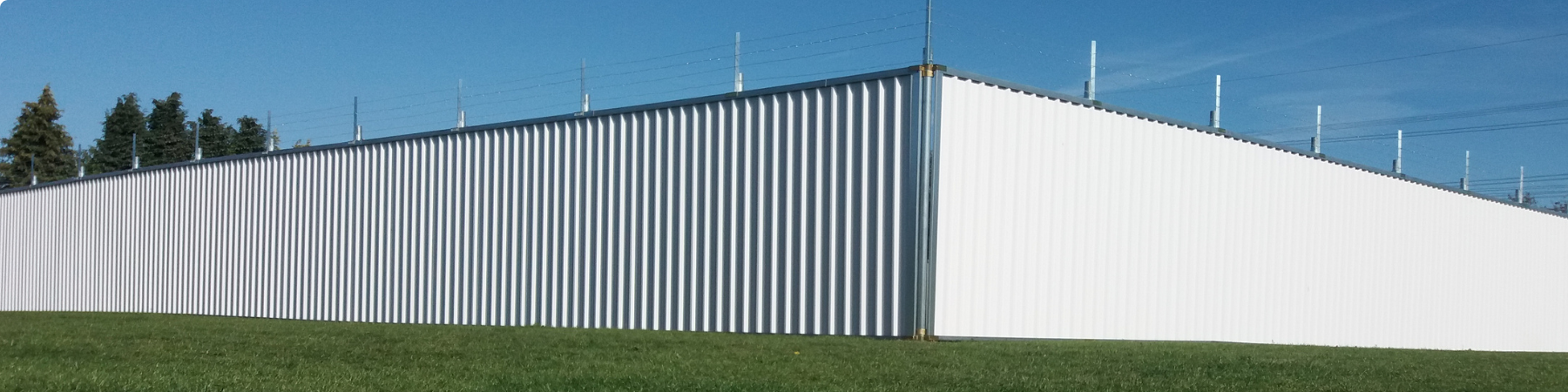
Rethync’s Multisite Hoarding is supplied at 2.4 metres high as standard, with configurations up to 3 metres incorporating additional security toppings available where required. The system uses 1-metre-wide galvanised and poly-coated steel panels which overlap within the framework to create a continuous external face.
Importantly, height should not be considered on its own. Ground conditions, wind exposure, the length and layout of the perimeter and the way the system is anchored can all affect the final site hoarding specification.
What should a site hoarding specification include?
A good hoarding specification starts with the individual site.
Factors to consider include:
Height and security
The level of security required will vary considerably between a housing development, demolition project, commercial construction site and a site next to a busy public area.
Higher-risk locations may require additional perimeter security, controlled gates or other deterrents.
Rethync’s Multisite system can also incorporate barbed wire toppings for projects requiring increased perimeter security.
Ground conditions
How the hoarding will interact with the ground is an important part of its design.
Rethync’s Multisite Hoarding is installed directly into the ground and can be configured to accommodate varying ground levels, gradients and curves. This allows the perimeter to follow the realities of the site rather than relying on a perfectly flat boundary.
Wind loading
Solid hoarding creates a significant surface area for wind to act against, so stability should form part of the planning process.
The HSE treats fencing and hoarding as temporary works and notes that, except in the simplest situations, temporary works may require designs and calculations.
Rethync provides temporary work calculations covering factors including wind loading, ground conditions, system configuration, anchoring and panel spacing.
Vehicle and pedestrian access
A continuous perimeter still needs practical access.
Vehicle deliveries, workers, visitors and pedestrians all need to move around a site safely, so gates should be considered as part of the hoarding design rather than being added as an afterthought.
Rethync offers vehicle gates, pedestrian gates and barn-door gate configurations that can be incorporated into the overall site perimeter. Its standard pedestrian gate is 1.1 metres wide, while standard Multisite vehicle gates are 5.4 metres wide.
Steel, timber, plywood or plastic hoarding systems?
There are several approaches to construction site hoarding, and the right choice will depend on how the site will operate.
Steel hoarding systems
Steel is particularly suited to contractors looking for a robust system that can be reused across different projects.
Rethync’s Multisite Hoarding uses galvanised and poly-coated steel panels designed to be dismantled, stored and installed again on future sites. Rethync states that its Multisite steel hoarding has a 10-year lifespan, making reuse a core part of the system rather than treating hoarding as a disposable site cost.
The system also uses no external posts or fittings on the public-facing side and does not require backstays, helping preserve usable space inside the compound.
For housebuilders and contractors moving between developments, this can make a reusable steel system particularly useful.
Timber and plywood hoarding
A traditional timber hoarding specification will usually be designed around timber posts, rails and sheet materials such as plywood.
The precise post spacing, plywood thickness, fixings and foundations should be based on the individual installation and structural requirements rather than assumed to be universal.
That is particularly important when researching terms such as plywood hoarding specification, because copying a generic specification from another development may not account for different wind exposure, ground conditions or site layout.
Timber can still be suitable for certain projects, but contractors should also consider what will happen to the materials when the project is complete.
Plastic hoarding systems
Plastic hoarding systems are another option available within the wider marketplace.
Specifications differ considerably between manufacturers, so factors including rigidity, anchoring, wind performance, fire characteristics, durability and suitability for the required security level should all be checked before specifying a plastic system.
It is also important not to confuse plastic pedestrian barriers with construction hoarding. Rethync supplies a number of HDPE and polyethylene barrier systems, but these perform a different function to its solid Multisite steel hoarding system.
Does site hoarding need temporary work calculations?
Site hoarding can form part of a project’s temporary works.
The HSE advises that temporary works need to be planned and managed properly and that designs and calculations will normally be required except in the simplest situations.
For hoarding, this can involve assessing:
- wind loading
- ground conditions
- proposed height
- overall configuration
- panel spacing
- anchoring
- gates and openings
- exposed sections of the perimeter
Rethync provides free temporary works calculations for its hoarding, fencing and barrier systems, helping determine an appropriate setup before installation begins.
This can be particularly valuable for large, exposed or irregular sites where a standard approach may not be appropriate.
Can construction hoarding be reused?
For contractors working across multiple developments, reuse can be one of the most important considerations when choosing an environmental hoarding solution.
Rather than manufacturing and disposing of a new perimeter every time a project changes, reusable systems can be moved between developments.
Rethync’s Multisite Hoarding has been specifically developed around this approach. Once one phase or development is complete, the system can be dismantled, stored and reinstalled elsewhere.
Rethync says its system has an expected 10-year lifespan and that customers commonly begin seeing cost savings by the second site use. The company can also manage the wider process, including installation, dismantling, logistics, storage and reinstallation.
For contractors operating multiple hoarding sites, this means the perimeter becomes an asset that can move with the business rather than a single-project purchase.
What about the appearance of the hoarding?
Site hoarding has a practical job to do, but it is also one of the most visible parts of a construction project.
On housing developments and projects close to communities, the external face may remain in place for months or even years.
Rethync’s Multisite panels are supplied powder coated white on one side as standard, with RAL powder-coated colours and on-site painting available as additional options. Steel hoarding can also be used for project messaging, artwork and branding.
That allows the perimeter to contribute to the appearance of the development while continuing to provide the required security.
How to choose the right hoarding system
There is no single best hoarding system for every construction project. The starting point should always be the site itself.
Consider how long the perimeter will be needed, the level of security required, surrounding public access, ground conditions, wind exposure, vehicle and pedestrian movements and whether the hoarding could be reused on future projects.
For contractors managing multiple sites, the lifecycle of the system is particularly important. A solution that can be installed, removed, stored and redeployed may provide more value than looking at the initial installation cost alone.
At Rethync, Multisite Hoarding is manufactured in-house and can be supplied, installed, dismantled, stored and reinstalled as projects progress. The system can be manufactured to suit runs from 20 metres to 2,000 metres while maintaining a continuous site perimeter.
Planning your next site perimeter?
Every construction site comes with different access, security and boundary requirements.
Rethync works with housebuilders, main contractors, civil engineers and demolition teams across the UK to design and install hoarding systems around the needs of each project.
From temporary works calculations and Multisite steel hoarding to gates, installation, dismantling and storage, the team can manage the perimeter throughout its lifecycle.
Speak to Rethync about the hoarding requirements for your next project.